Ode to Technology: How Stenography Turned Dostoevsky's Deadline into a Love Story
The Shorthand Magic and the Rom-Com Behind Dostoevsky's Literary Lifeline

I talk to dead writers. That’s how I learned about how stenography liberated Dostoevsky from financial and personal ruin.
They say that reading is basically talking to the dead. This comes from Zeno, the founding father of Stoicism. At some point, Zeno was shipwrecked and lost all his fortune near Athens around 300 BCE. He went to see the Oracle in Delphi. She told him that to find a new purpose, he should ‘take on the color of the dead’. Now, it is true that Zeno (and Socrates before him) both urged everybody to ‘talk to the dead’. I can’t honestly tell you how the phrase ‘taking on the color’ mutated into ‘talking to the dead’. But I don’t speak Greek, and I am no philosopher, so what do I know?
But the next leap - from ‘talking to the dead’ to reading texts, especially as active participants - that I totally get and embrace. We shouldn’t just read the text for what it says on the page. We are invited to enter into an active conversation with the story. What does this mean for me, right now? If it happens the way the words describe here, how would it happen in different circumstances? Oh, wait, the hero does X here. I wonder what I would do in his shoes? Or why he didn’t just do Y. Why does the author prefer that other option?
It’s like reading a story, then discovering a whole new dimension of possibilities and ideas, a different window into the world, and your own mind. The better the book, the more avenues to engage in these side conversations.
I take this even further. Not only do I often venture into these mental side quests about the book’s narrative, I also obsess about the lives and challenges or practical circumstances of the authors. I know, talk about time on my hands. For what it’s worth, this is precisely how I think about historical figures, kings and rulers, or ordinary people in the past. How did they bathe? The teenagers had acne, too, right? What did they eat? How did the women navigate menopause? Did they really exchange written messages, sometimes several in one day, through their servants? Was that a thing among 19th-century nobility?
Anyway, so in related news, I read “The Brothers Karamazov” over the winter break. It’s a gigantic book, literally. And I knew it was a big fat book. I remember peripherally the spines of not one but two hefty, grey-colored volumes sitting on the bookshelf in my parents’ living room, just as I remember the covers of a few books that faced the room. These books always remained in the same spot. I would occasionally dust all the bookshelves that ran wall to wall. It never occurred to anybody to rearrange the books, to ‘freshen up’ the look, or, god forbid, arrange them by color or switch those covers facing the room with different ones. I can still see collections of Lawrence Ferlinghetti’s and Jacques Prévert’s poems and their exact spot in the library. They just sat there for decades. Over the years, books were taken out, read, then placed back in the same spot: the unchanged literary wallpaper of my childhood.
So I knew The Brothers Karamazov was a big book. I mean, the audiobook version is forty-five hours! But it’s more than a lot of words on a lot of pages. It tells a story, yes, but it meanders into philosophy, psychology, political issues of 19th-century Russia, such as the abolition of serfdom, the role of the Orthodox Church and its clergy, and, of course, Faith.
I was blown away. And I kept thinking: goodness, this is The Infinite Jest of the 19th century!
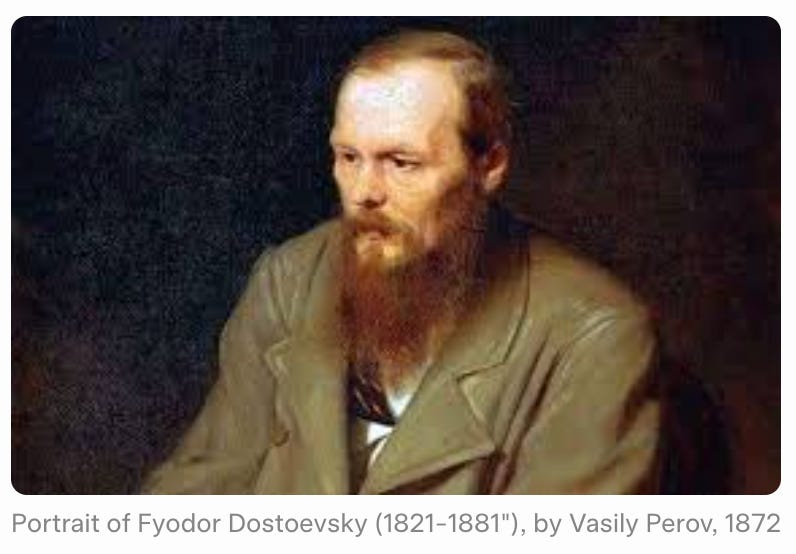
And so here I was, conversing with Dostoevsky. His image in my mind’s eye was the very famous oil painting by Vasily Perov. (We actually had a reprint of that portrait in my high school textbook. And I remember thinking back then how morose and old Dostoevsky looked. It’s only now and with some humility that I realize that I’m basically the same age as Fyodor Mikhailovich was when it was painted.) Anyway, I kept thinking of the parallels between him and David Foster Wallace. Their styles are very similar, almost manic in scope and delivery, heady and all-encompassing.
I could imagine the room where D. F. Wallace wrote. I could envision how he worked, eyes glued to the 1990s computer monitor that resembled a spatial triangle extruded into 3D form. That narrow screen exploding into a thick, protruding rear hump.
Perhaps it’s because he was my generation, and I could picture him typing frantically on the loud clicking keyboard, getting into a manic outburst. Maybe my mind was corrupted by the scenes from the wildly underrated movie about him (The End of the Tour, 2015, where Jason Segel plays the writer). Regardless, David Foster Wallace’s writing - as epic as it is - is somehow tangible for me. I can just picture him: high, perhaps, definitely in a frantic haze, depicting the interwoven storylines and different worlds with insane urgency, describing them so vividly, portraying human depravity as well as life’s ironies. The Infinite Jest is a huge sweeping tableau. And D.F. Wallace possessed a mad genius headspace and a very good word processor.
But, I kept asking: Fyodor Mikhailovich, how the hell did you do it? How does one physically produce a 400,000 words masterpiece without a computer?
Was he drinking? Taking drugs? It’s known that Dostoevsky was a notorious gambler, but he wasn’t a substance addict. No, he wasn’t an alcoholic - well, not by the Russian standards, anyway. (His friend once described how Dostoevsky drank vodka in the morning while chewing on some dark bread, and, for what it’s worth, his friend thought it was the healthiest way, anyway). Dostoevsky wasn’t experimenting with opiates or anything like that. He was on potassium bromide for his epilepsy, but that’s not exactly cocaine. He couldn’t have written all of this with ink and paper, could he? Longhand, really? Or, were there typewriters? Negative, the mass production came a few decades after his big works were already published. So how did he do it?
The answer, my friends, is stenography. A method of rapid writing that uses symbols and abbreviations to capture spoken words at speeds matching or exceeding normal speech.
A genius technology
I always associated stenography with the perky secretaries in the old black-and-white movies. Or, in more modern films, a stenographer would be that one weird, somehow always corpulent, lady sitting in the courtroom, her fingers flying on a very odd miniature typewriter that had only like five keys. But now, thanks to the conversation I started with Fyodor Mikhailovich in my head, I’m down this rabbit hole, learning that we can trace stenography all the way to early civilizations in Egypt, Greece, and China? Apparently so!
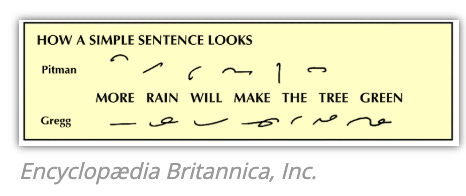
This is how I learned that here in the West, we had this guy Xenophon, a student of Socrates in the 4th century BCE. And he likely employed a primitive form of shorthand - think mnemonic abbreviations and symbols to record Socrates’ conversations and teachings pretty much word for word. I’m sorry, what? You’re telling me that the basis for Socrates’ Memorabilia, a text that defended and immortalized the philosopher’s ideas, that contributed to the foundation of Western civilization, is here only because this dude Xylophone invented a way to write real fast? If this is not the most beautiful testament to technology making us leap forward, I don’t know what is. Because, as smart as he was, Socrates never bothered with written words. Or none survived. Sure, we got most of his wisdom from Plato. But without his student Xylophone, a huge chunk of Socrates’ legacy could have vanished when he kicked it.
Stenography is truly fascinating. Cicero used it. Julius Caesar famously utilized it (by then they used what was called Tironian notes) for efficient note-taking during his campaigns and deliberations. It waned during the Middle Ages, often dismissed or feared as a form of magic. I mean, I get it: it uses cryptic symbols only the initiated may decipher. And mastering it takes a long time. As a technology, it captures ideas and helps them disseminate faster. The Church was not a fan. And for a good reason, Luther’s sermons were documented through shorthand methods, allowing his theological ideas to spread widely during the Reformation.
In any case, the rise of commerce in 16th-century Europe helped to resuscitate the stenography practice with modern phonetic systems. Charles Dickens mastered Brachygraphy, a complex system he described as a ‘savage stenographic mystery’, which he used during his early career as a parliamentary and court reporter before incorporating it into his writing process. See, technology shapes the outcomes! Marshall McLuhan would grin.
In the 19th century, stenography not only regained prominence but became a pivotal tool for literary productivity. Our dear Fyodor Mikhailovich was beyond prolific. Because he ‘wrote’ as fast as he spoke! Which was a good thing because Dostoevsky was repeatedly in gambling debts, so for him, finishing and publishing the next thing was his only way to avoid prison when he was late on payments.
The Third Act
And here is where my stenography side quest that started with just wondering about Dostoevsky’s writing habits truly paid off: I got to learn about Dostoevsky’s stenographer, Anna Grigorievna Snitkina. First of all, the scene: it’s 1866, and Fyodor Mikhailovich is a 45-year-old widower who is under an impossible deadline. He must finish a novella (what would become The Gambler) because if he doesn’t, he will lose rights to all his future writing. So he hires Anna, a stenography student. First of all, Anna is whip smart and top of her class. Second, she is practical and has no time for Dostoyevsky’s financial and organizational mess. Third and bonus: she’s adorable.
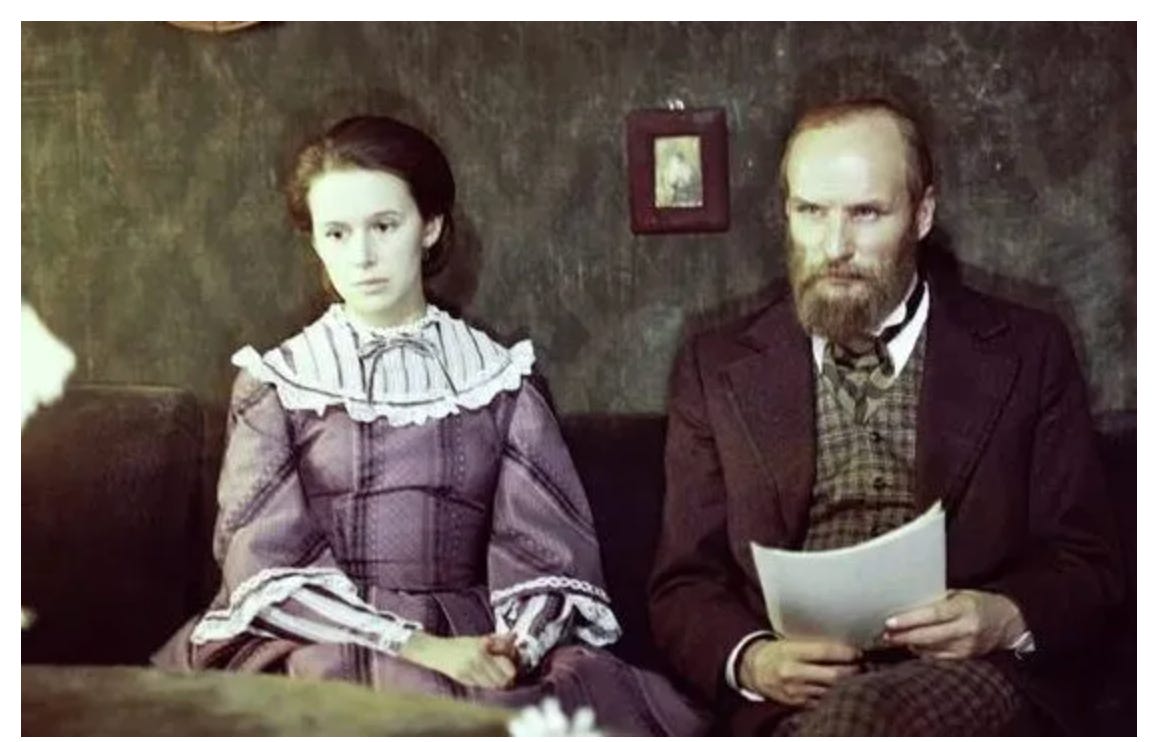
Enter 19th century romance, Jane Austen style: the cute 20-year-old stenographer would show up in Fyodor Mikhailovich’s apartment in St Petersburg to take his dictations from noon to 4 PM, every day. Anna would then rush home to rewrite the shorthand into the longhand and bring it back the next day for edits. Anna wasn’t just a typist, she would also provide feedback and ideas. Over the course of their time working on The Gambler together, she develops deep respect for the creative process and admiration for the author. They beat the deadline, and the manuscript was completed in 26 days. Fyodor Mikhailovich, whose first wife passed away from tuberculosis, falls in love with Anna and marries her the following year.
There is no doubt that Anna was an exceptional transcriber. But she was much more than that. She straightened out Dostoevsky’s chaotic affairs, managed his debilitating gambling debts, handled business negotiations with publishers, and raised their children.
They had four together: the firstborn daughter, Sophia, sadly died at three months. Then they had Lyubov (called Aimee) and Fyodor Jr., and then the youngest son, Alexey. Tragically, Alexey didn’t survive an epileptic episode when he was 3 years old. In a related connection, by far the best brother of the Brothers Karamazov is the infinitely good Alexey (Alyosha). Reading the book, I wondered about Dostoevsky writing this particular character. How he had to be in dialogue or mental and spiritual connection with his son, who never got to grow up. Yet how this character allowed Dostoevsky to imagine the young man he could have become, or who he, as a father, wished he would become: a pure soul, a deeply good, thoroughly nonjudgmental man. Dostoevsky created Alyosha’s later life on paper, even if the little boy didn’t live. There must have been so much re-experienced and channeled into all the book’s sections about Alexey.
Dostoevsky got to experience fatherhood and the joys and tragedies of a family life thanks to Anna. She provided stability that allowed Dostoevsky to focus on writing. She was the home he didn’t think was in the cards anymore.
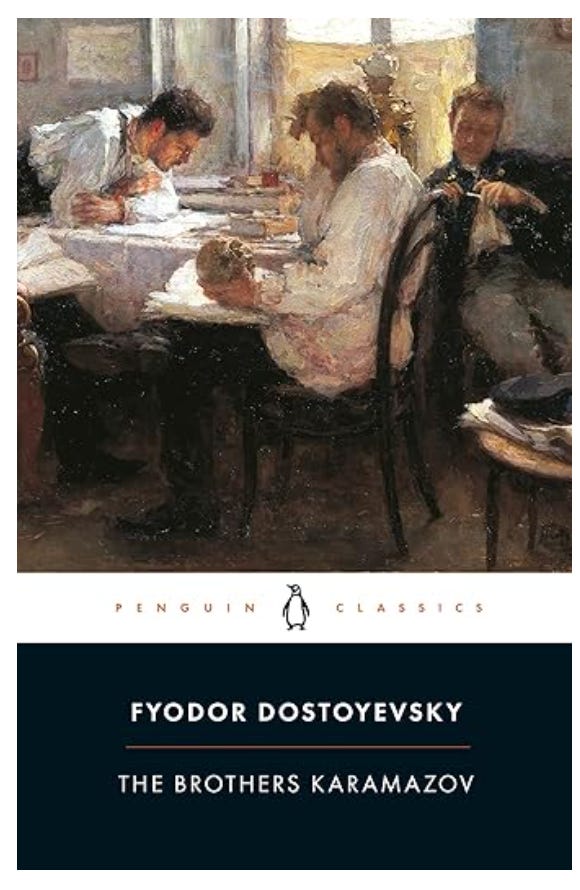
Without stenography, they wouldn’t have met. It was their meet-cute. Without active reading and thinking about the practicalities of his writing, I would have never learned about stenography or the key role it played in the author’s life. And that’s all on top of reading the most breathtaking whodunnit of the 19th century, The Brothers Karamazov. Go read this masterpiece. Talk to the characters and maybe the author, too, while you're at it. Start your own side quest
!